
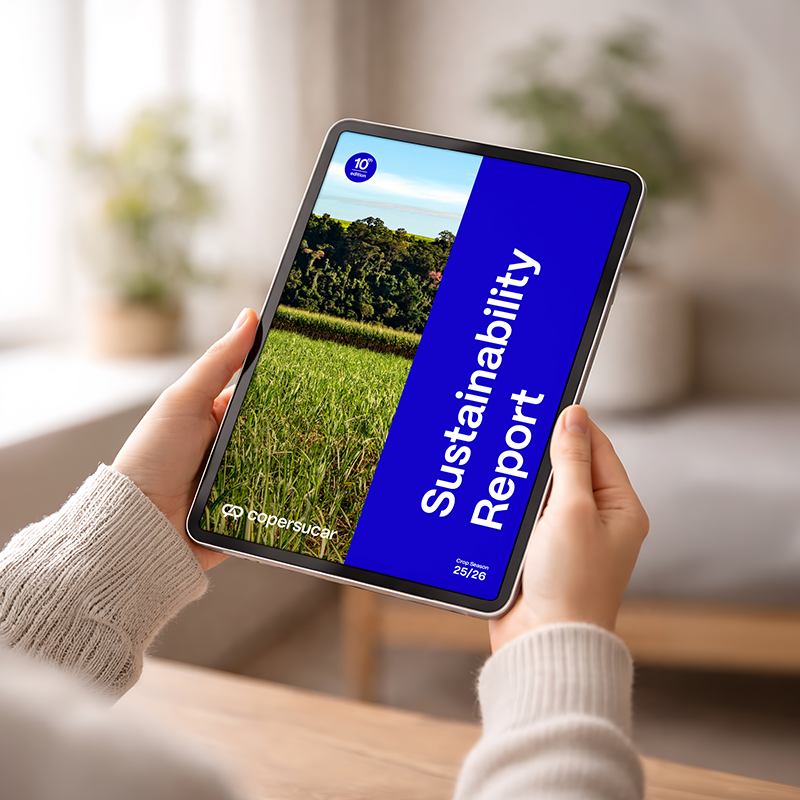
Copersucar launches Sustainability Report Crop Year 25/26, with advances in decarbonization, bioethanol in shipping and biomethane
Publication brings together the company’s environmental, social and economic results, with emphasis on the first bioethanol bunkering of a deep-sea containership in Brazil and the expansion of the use of biomethane in logistics.
Key highlights:
- A record in the volume of bioethanol sold avoided the emission of 30 million tons of CO₂eq, corresponding to the annual emissions of more than 14 million gasoline-powered vehicles.
- Generation of 6.5 thousand GWh of renewable electricity by the partner mills from biomass, equivalent to 10% of all Brazilian electricity generated from biomass.
- A 150% increase in the use of biomethane in the crop, with 6.5 million m³ used in logistics and industrial operations, avoided the consumption of 6 million liters of diesel and the emission of 15 thousand tons of CO₂
- Advances in the generation of CBIOs (decarbonization credits), TERCs (carbon credits in the North American market) and Bonsucro credits, expanding the value generation from the environmental and social attributes of the products sold globally.
- Food security: as the world’s largest sugar trader, Copersucar has contributed to feeding approximately 500 million people in more than 70 countries.
- Social impact: 1.4 million people benefited from 123 projects supported by the Copersucar Ecosystem in Brazil.
São Paulo, September 3, 2026 – Copersucar, a business ecosystem that offers renewable energy solutions at scale and a global leader in the trading of sugar and bioethanol, presents its Sustainability Report for the 25/26 Crop Year.
Decarbonization
Among the main results is the advancement of bioethanol’s contribution to the decarbonization of road transportation. The record in the volume of bioethanol sold by the operations of the Copersucar Ecosystem in Brazil and the United States avoided the emission of 30 million tons of CO₂eq, a volume comparable to the annual emissions of more than 14 million gasoline-powered vehicles.
As part of the renewable solutions agenda for new markets, Copersucar reached an unprecedented milestone in enabling the use of bioethanol in maritime transport: the first bioethanol bunkering of a deep-sea containership in Brazil, carried out at the Port of Santos, in July 2026, as a result of two years of work with partners in the maritime and port sectors, and authorities. Bioethanol reduces CO2 emissions by between 70% and 80% compared to the fossil fuel used in shipping.
On the same front of decarbonization in hard-to-abate sectors, Copersucar expanded the use of biomethane in cargo transportation and industrial operations. In the 25/26 Crop Year, the replacement of 6 million liters of diesel with biomethane – a volume 150% higher than that recorded in the previous crop – avoided the emission of 15 thousand tons of CO₂eq.
This evolution is mainly due to the consolidation of BioRota Copersucar, Brazil’s largest sustainable logistics operation powered by biomethane. Created in 2024, the initiative replaces diesel with biomethane produced from sugarcane residues and, in the first two years of operation, accounted for 14% of the volume of sugar transported by road from the associated mills to the Port of Santos, with more than 70 trucks and seven partner carriers.
The generation of renewable energy from biomass also advanced in the 25/26 Crop Year. The partner mills generated 6.5 thousand GWh of electricity from sugarcane biomass, representing 10% of all electricity generated in Brazil from biomass, equivalent to the annual consumption of a city the size of Rotterdam, in the Netherlands.
Low-carbon logistics
Complementing initiatives aimed at reducing emissions in transport, Copersucar continues to make progress in optimizing its multimodal logistics. In the 25/26 Crop Year, 60% of the sugar was transported by rail and thereby avoided the emission of 70 thousand tons of CO₂eq, compared to 53 thousand tons in the previous crop. The transportation of bioethanol by pipelines removed 95 thousand trucks from urban areas and avoided the emission of 88 thousand tons of CO₂eq.
Environmental management
In the management of GHG emissions, even in the face of the increase in sugarcane production and the greater demand for agricultural inputs, the Copersucar Ecosystem maintained its efficiency, with an intensity of 48.35 kilograms of CO₂ per ton of crushed sugarcane. The result reinforces advances in emissions management and the adoption of solutions with lower carbon intensity. Copersucar received the GHG Protocol Gold Seal for the ninth consecutive year.
Social impact and food security
In the social field, the Copersucar Ecosystem directly and indirectly benefited 1.4 million people through 123 projects. The investments totaled R$ 8.5 million and included initiatives in education for sustainability, sports, culture, health and scientific development in the sugar-energy sector. Among the projects, the partnership with the organization De Olho no Material Escolar, together with the associated mills, focused on training teachers and students from the public education network on agribusiness and the sugar-energy sector in 13 municipalities across three states, stands out.
The company’s performance also reinforces its role in global food security: the trading of sugar contributes to feeding approximately 500 million people in more than 70 countries.
Sustainability credits
In the United States, the sale of 250,000 TERCs (Transport Emission Reduction Certificates) – credits that recognize reductions in greenhouse gas emissions associated with the use of lower-carbon fuels, such as bioethanol – resulted in the mitigation of 250,000 tons of CO₂eq.
In Brazil, the partner mills issued 6 million CBIOs (decarbonization credits) under RenovaBio, and 227 thousand Bonsucro credits were sold, attesting to the sustainability of sugar and bioethanol production and maintaining Copersucar’s position as the world’s largest sugar trader.
“The economic, environmental and social results presented in the 25/26 Sustainability Report reflect the ability of the Copersucar Ecosystem to generate value consistently. By connecting producers to global markets, developing new applications for renewable products and continuously promoting innovation, we strengthen the competitiveness of our value chain, generate positive impacts for millions of people and expand our contribution to sustainable development,” said Tomás Manzano, CEO of Copersucar.
These and other results are detailed in the Sustainability Report Crop Year 25/26, available on Copersucar’s website.
About Copersucar: Copersucar develops and provides large-scale renewable energy solutions that contribute to the energy transition and global food security. Organized as an integrated ecosystem of specialized businesses, the company is a global leader in the trading of sugar and bioethanol and operates an efficient multimodal logistics system. In bioethanol, it serves the Brazilian market through Evolua Etanol and the North American market through Eco-Energy, which also operates in natural gas trading. In biomethane, the company connects supply from producers, including partner mills within its ecosystem and third parties, with demand from customers seeking renewable alternatives to natural gas and diesel, contributing to the decarbonization of different sectors of the economy. In sugar, in addition to the domestic market, the company serves customers in more than 70 countries through Alvean. Copersucar also operates in the renewable electricity sector through Newcom and is a shareholder in Logum, Brazil’s largest bioethanol pipeline transportation system, and Centro de Tecnologia Canavieira (CTC), the world’s largest sugarcane R&D center. With integrated operations across different renewable energy value chains, Copersucar combines scale, market knowledge and commercial capabilities to develop new solutions and connect its products to evolving markets. To learn more, visit: www.copersucar.com.br
Press Information: Néctar Comunicação – copersucar@nectarc.com.br